What the Woman Carried


What the Women Carried
An evolving project in inheritance, color, and self-portraiture
This project began with the oranges Hixson’s grandmother, Edith Nod Knight, sent his family. Their arrival became a recurring gesture of affection: something to unwrap, share, and remember. As Hixson translated the fruit into circles, layered color, and rhythmic marks, the paintings became an abstract record of that exchange.
Edith’s gift places a woman at the center of this family history. Through her oranges, Hixson considers how inheritance travels through everyday gestures—how something offered by a grandmother can become a memory, a tradition, and eventually a painting.
Hixson turns this question toward the women in his lineage. He wants to give their presence sustained attention: the gifts they exchanged, the relationships they maintained, and the gestures through which family history became part of daily life. The orange becomes a way to approach inheritance through touch, nourishment, and memory. Its repeated forms suggest generations connected without becoming identical.
The project also makes room for the military histories associated with the Hixson name. Alongside those accounts, Hixson asks how women’s lives will be remembered and pictured. His developing abstraction holds space for both public histories and intimate forms of continuity, tracing the people whose influence survives in habits, objects, stories, and acts of care.
Hilma af Klint, Hixson’s most cherished painter, offers an artistic point of connection. Her use of yellow and blue to signify masculine and feminine principles resonates with his experience of gender as movement, coexistence, and possibility. In his own practice, color becomes a means of considering how apparently separate identities can inhabit one person.
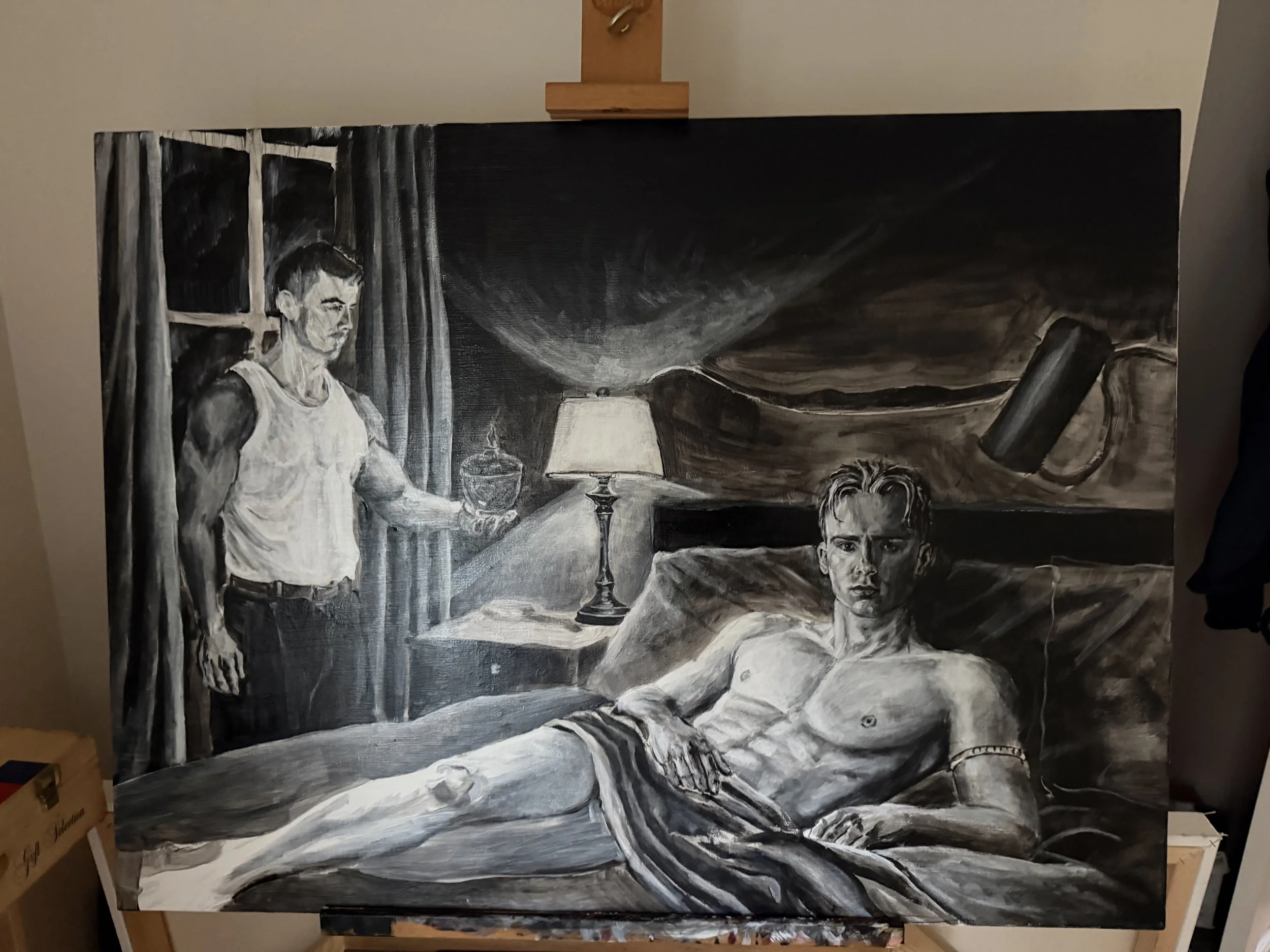
These questions continue in a self-portrait currently in progress, informed by Titian’s Venus of Urbino and Édouard Manet’s Olympia. Hixson places his own body within that pictorial conversation as a contemporary sex worker, claiming the authority to compose his image and return the viewer’s gaze. He appears reclining beside a hired bodyguard who offers him a glass of wine. Protection and intimacy occupy the same room.
The objects surrounding him form a personal symbolic language. Wine and a hairbrush invoke Mary Magdalene within Hixson’s interpretation; a bow and arrows refer to Artemis, whom he experiences as a protective spiritual presence. A cuff becomes an ornament of Venus and beauty. Through these associations, Hixson brings sexuality, spiritual devotion, adornment, and bodily autonomy into a shared composition.
His reading of Adam and Eve imagines an original wholeness encompassing masculine and feminine qualities before their separation. This becomes his own proposition of spiritual perfection: a body capable of holding gender’s multiplicity.
The portrait also engages contemporary “looksmaxxing” ideas about proportion and idealized appearance. Hixson brings those systems into conversation with inherited artistic ideals, examining how a body is measured, constructed, desired, and given value.
For the developing color layers, he intends to build transparent glazes so that earlier passages remain active beneath later ones. Color will accumulate through the surface rather than being fully resolved on the palette. This method gives material form to the project’s central concern: a person emerges through layers of inheritance, influence, choice, and experience.
According to Hixson’s family history, this lineage includes Timothy Hixson, a Revolutionary War veteran, and a Civil War lieutenant who married Emily Jane Hixon. Within that history, Emily Jane becomes central to the transmission of the name: it passed to Henry Hixon Meyer Sr., then to Henry Hixon Meyer Jr., and eventually to Andrew Hixson Meyer, who makes art as Drew Hixson.
For the artist, carrying the name connects military remembrance with the women through whom family identity endured. Edith’s gifts of oranges offer another form of inheritance—one experienced through affection, anticipation, and the senses. The paintings bring these inheritances together: a name carried through generations and a grandmother’s gesture translated into color.
Among his grandmother’s thirty-six grandchildren, Hixson drew heir to the entrusted family name. He carries it thanks to his mother and his grandmother, Edith, whose choices made that inheritance his own. Their place in its passage is central to this project: the name connects him to generations of family history, and to the women who chose to carry that history forward through him.
By working as Drew Hixson, he gives the inherited name a continuing life in art. Edith’s oranges and his mother’s gift of the name become connected expressions of belonging—one remembered through color and taste, the other spoken and signed.
The oranges still to this day remain Drew’s unique way of telling their own story. Within their expanding forms, Hixson seeks a family history that can make the women visible—and a place for the person they are still becoming.
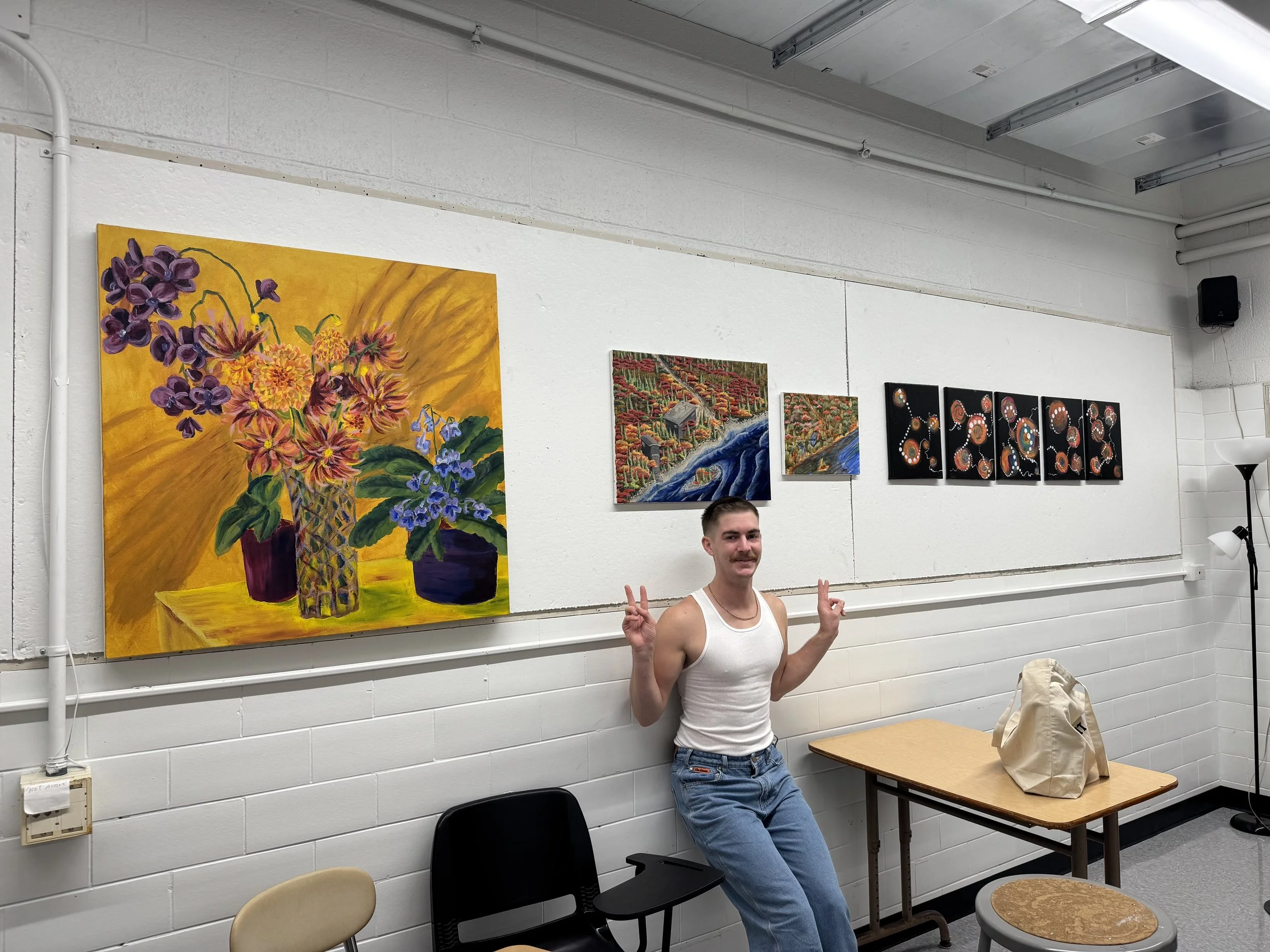


The Essence of a Gifted Orange, October 2025, Acrylic on Canvas, Five Panels each 8.5” x 11”
The Drawings that Inspired the Series


