
Devastatingly Beautiful
-
Devastatingly Beautiful -
Devastatingly Beautiful
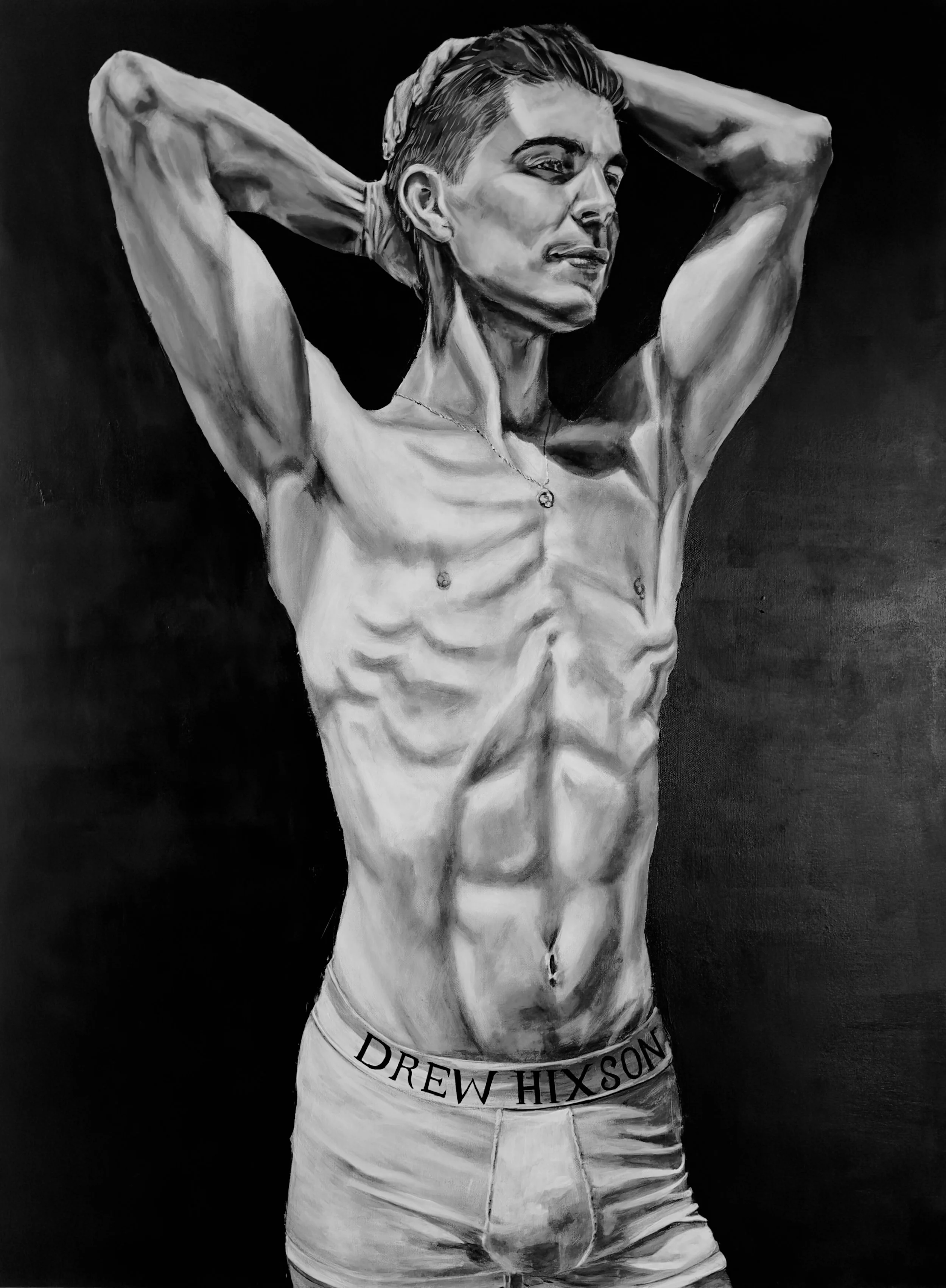
Devastatingly Beautiful, February 2026, Acrylic on Canvas, 3’x5’
This painting is meant to be encountered first through desire. Hixson invites the viewer's initial response to be simple and uncritical: he is beautiful. The pose, lighting, and sculpted body deliberately borrow from the visual language of hyper-sexualized fashion advertising, echoing imagery long used to define masculine desirability, particularly within gay culture, where bodies are often treated as currency, proof, and protection.
Only with time does the discomfort surface. The body that appears disciplined and idealized is not a symbol of health, but the physical manifestation of an eating disorder at its height. As a gay man, Hixson experienced heightened pressure to conform to narrowly defined ideals of masculinity, leanness, and control. Praise directed at his appearance, meant as affirmation, quietly reinforced anorexic behaviors, rewarding self-erasure under the guise of beauty.
The painting confronts how admiration can become complicit in harm when it fails to ask deeper questions. What reads as confidence is sustained by restriction; what appears powerful is rooted in fragility. By presenting the body in a format associated with desire and consumption, Hixson exposes the violence embedded in systems that reward suffering when it aligns with cultural fantasy.
Yet the act of painting this body became an intervention in recovery. To render every rib, tendon, and shadow with care was not an act of glorification, but of confrontation. In translating the photograph into paint, Hixson slowed the gaze that once fixated on control and redirected it toward understanding. The canvas became a site where denial dissolved. What once functioned as proof of discipline was reframed as evidence of harm. Through the discipline of painting, he reclaimed authorship over an image that had long dictated his sense of worth. The work stands not only as documentation of illness, but as a turning point in healing.
The painting also resists the myth that recovery is singular. Sobriety from substances does not inoculate someone against other forms of self-destruction. Within recovery communities, there can be quiet hierarchies of suffering, where visible abstinence obscures invisible struggles. Hixson’s experience reflects a more complicated truth: it is possible to be in recovery from one disorder while another remains active, praised, or misunderstood. This work insists that recovery must never be seen as linear, and that healing demands attention to the quieter disorders that often hide behind socially rewarded aesthetics.
Ultimately, the work asks the viewer to reconsider their relationship to bodies, especially those they are taught to desire. It leaves us with a quiet reckoning: there is very little space for commenting on another person’s body, because we rarely know what it costs someone to look the way they do.